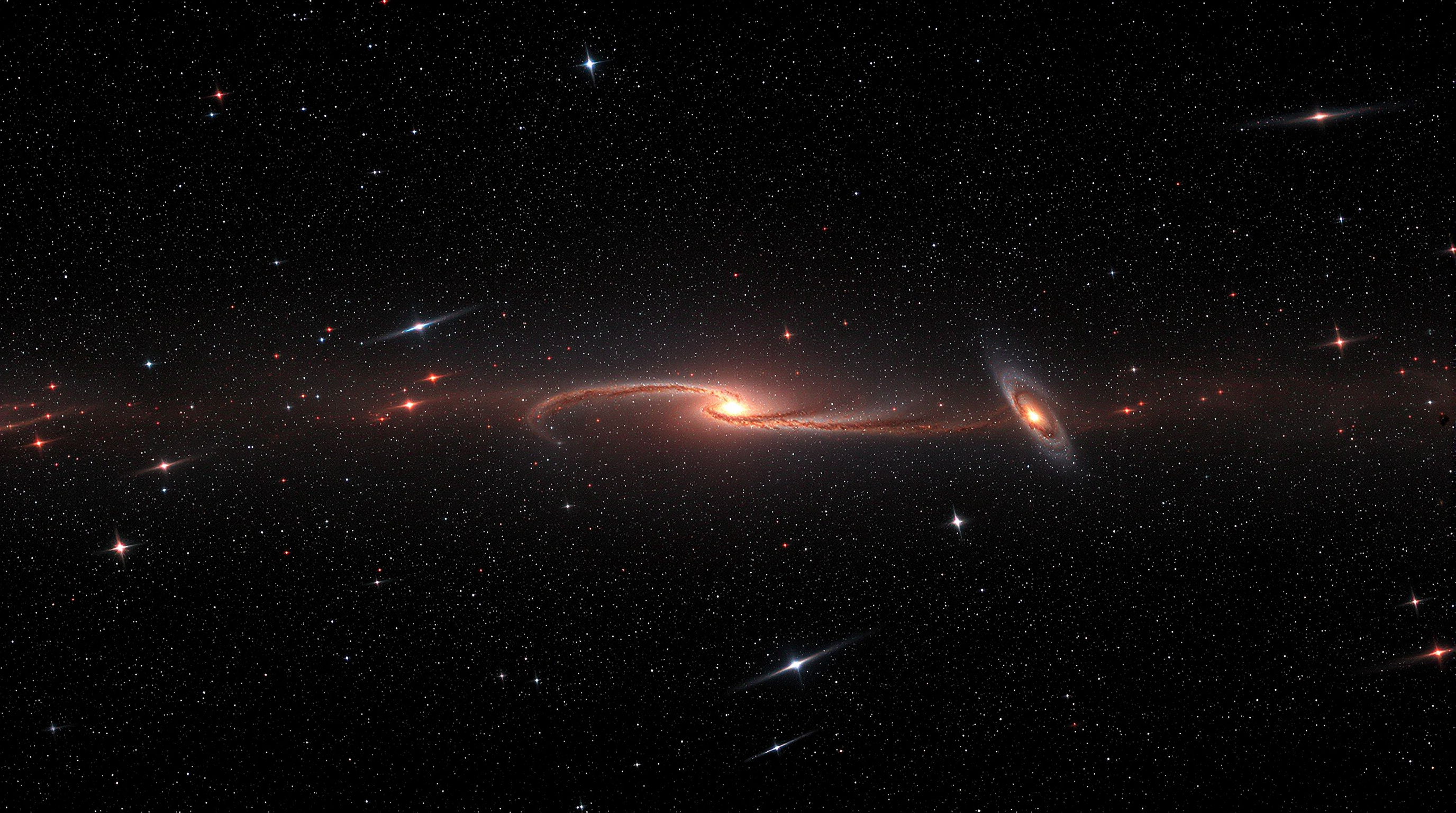
The James Webb Space Telescope's observations of distant galaxies raise questions about brightness, chemical enrichment, and the emergence of organised structure. These questions deserve close attention from a creation perspective, together with an accurate account of what astronomers have measured and how they interpret those measurements. A surprising galaxy can challenge expectations about galaxy formation without settling the separate question of cosmic chronology.
What Webb Means by "Cosmic Dawn"
ESA/Webb describes Cosmic Dawn as the first few hundred million years after the big bang, when the first galaxies were born in the conventional account. Observations of these galaxies help astronomers investigate how gas, stars, and black holes were changing during that period. The expression names a stage in the Big Bang framework; using it to explain a research result does not mean that the observation independently establishes that framework.
Redshift provides a central measurement in these reports. ESA/Webb explains it as a measure of how much a galaxy's light has been stretched by the expansion of the universe. Its JADES account describes using infrared images to select galaxies for further spectroscopic observations. Keeping this sequence in view helps readers distinguish the initial selection of a promising object from the spectrum used to investigate it.
JADES-GS-z14-0
In its May 30, 2024 account of JADES-GS-z14-0, ESA/Webb reported a galaxy observed only 290 million years after the big bang. The team used NIRSpec to obtain its spectrum and determined a redshift of 14.32 (+0.08/-0.20). ESA/Webb described it as the most distant known galaxy at that time, while explicitly noting that the highlighted science had not yet been through peer review.
That qualification belongs with the announcement. A record is a comparison with objects known at the time of a report, and the reported uncertainty is part of the measurement. JADES-GS-z14-0 provides a useful reference when considering the later MoM-z14 result. Reading the reports together also keeps the measured redshifts distinct from the times assigned to them in the conventional history.
MoM-z14 and the Nitrogen Puzzle
NASA's January 28, 2026 report describes confirmation of MoM-z14 at a redshift of 14.44 using NIRSpec. Within the conventional framework, NASA places it 280 million years after the big bang. The report identifies it as part of a growing population of bright early galaxies numbering 100 times more than theoretical studies predicted before Webb's launch. That comparison concerns the unexpectedly abundant population, rather than a statement that this individual galaxy is 100 times brighter than expected.
The chemical question is especially interesting. NASA reports that, at the time assigned to MoM-z14, there was insufficient time for generations of stars to produce its high nitrogen abundance in the expected way. One possibility the researchers discuss is that dense early environments produced supermassive stars capable of making more nitrogen than stars observed in the local universe.
This proposed explanation is part of the researchers' interpretation. The result asks how enrichment could proceed under early conditions; it does not identify a settled mechanism. NASA's account presents a gap between predictions and observations as a question for further exploration within cosmological research.
A Spiral Galaxy Candidate at Redshift 5.2
The surprise is not confined to brightness or chemistry. Swinburne's April 17, 2025 report identifies Zhúlóng as the most distant spiral galaxy candidate known at that time. At a redshift of 5.2, it is placed just 1 billion years after the Big Bang. The reported structure includes a central old bulge, a large star-forming disk, and spiral arms.
Swinburne contrasts this mature organisation with expectations that large spiral galaxies take several billion years to form and that galaxies in the first billion years would be small, chaotic, and irregular. Its account frames the finding as a reason to reassess how and when galaxies take shape. The word "candidate" remains essential: an intriguing classification should retain the qualification given by its source.
How Astronomers Interpret These Galaxies
These reports concern related but different questions. JADES-GS-z14-0 and MoM-z14 extend the spectroscopic frontier described by ESA/Webb and NASA. The MoM-z14 report also asks how bright galaxies became numerous and chemically enriched so early. Zhúlóng raises a question about organised galactic structure at the epoch assigned to it.
The institutions discuss these observations within the Big Bang framework. Their surprises should be represented at the level the sources describe: challenges to expectations about abundance, enrichment, and galaxy formation. A useful reading asks which expectation is being tested, what was actually measured, and whether an explanation is established or proposed. Those distinctions keep a discovery's significance in proportion to the evidence.
A Creation Perspective
From a creation standpoint, the brightness and organisation described here invite reflection on purposeful initial structure. This is the site's perspective on the observations. The cited institutions do not interpret these galaxies as support for a young universe, and their reported epochs belong to their conventional cosmological framework.
These findings also give concrete subjects for considering the distant starlight problem: measured spectra, galaxy properties, and the relation between redshift and the history assigned to an object. A creation explanation should address those observations together. Respect for the evidence includes acknowledging the researchers' proposed explanations, the qualifications attached to candidates, and the questions that remain open.